Infinite Concept Universe research · make · build · play
Impossible Weather Atlas / Reality Bridge

ICUD-008 · interactive explainer

Impossible Weather Atlas
Reality Bridge

Turn each fictional weather study toward the real atmospheric or optical mechanism that inspired part of its appearance. The art stays fictional. The science stays source-backed.

IMAGINEDExisting ICU procedural artwork. It is not a photograph, observation, forecast, or scientific capture.
REAL MECHANISMInstitutional-source-backed explanation. Diagrams are ICU interpretation and are not to scale.

How to read this: Every card identifies a limited visual borrowing, the point where the artwork becomes impossible, and the sources behind the explanation.

Petal Storm

Partial visual analogue · borrowed motion, impossible organization

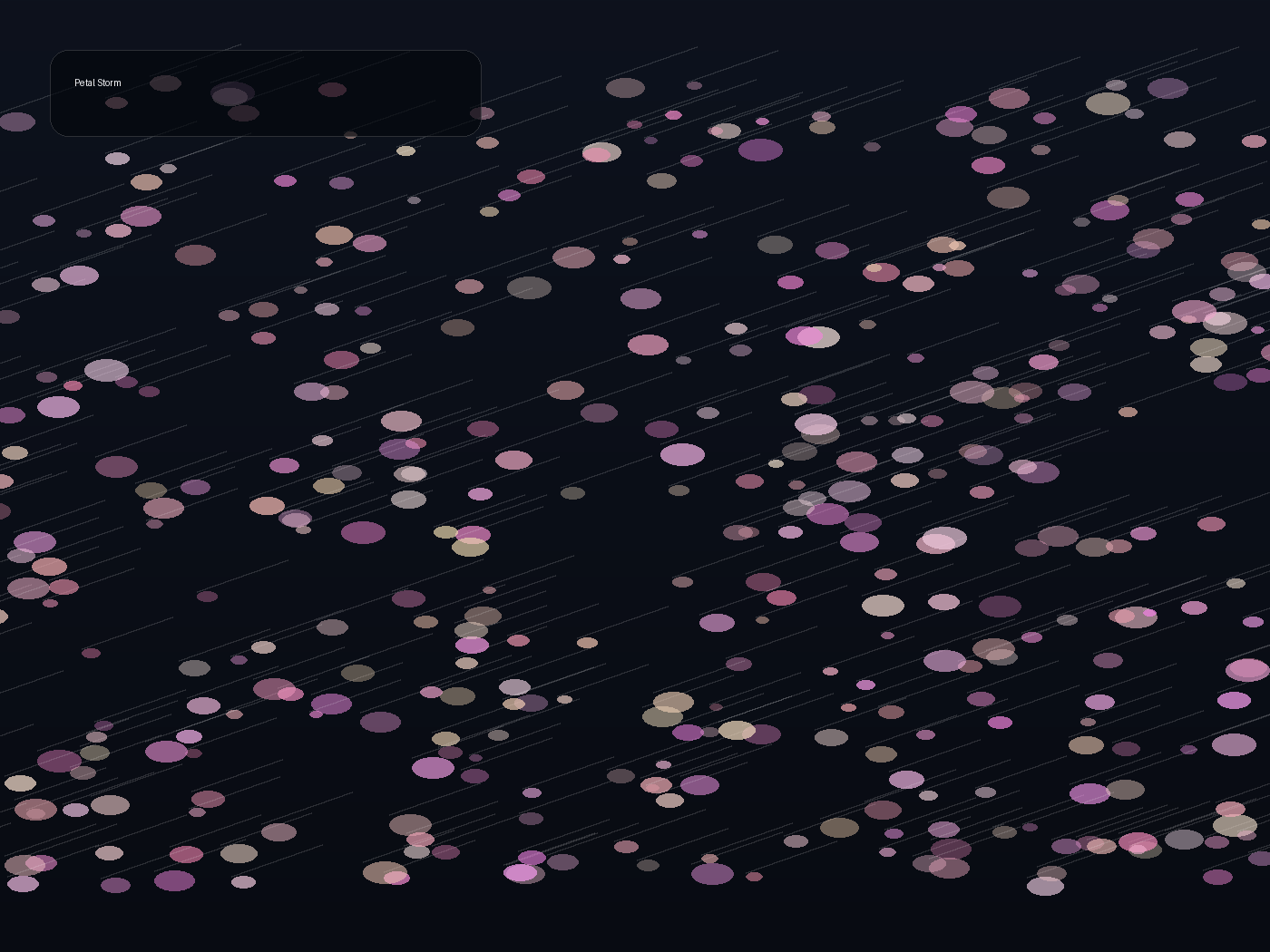
Fictional procedural artwork of luminous petal-like forms sweeping in layered currents over a dark horizon.
Imagined · ICU procedural art
Existing O037 artwork, reused without alteration. Not a weather observation.

Imagined phenomenon

Glowing petals that hold a storm-scale ribbon

Petals sweep as if the atmosphere has arranged them into evenly spaced luminous bands.

Real mechanisms

Turbulent transport and settling

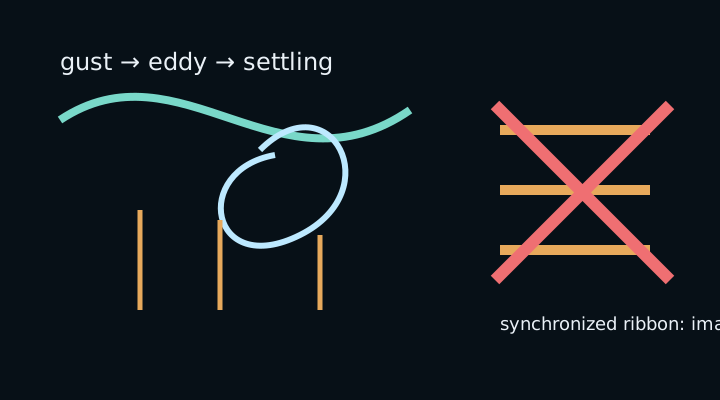
Irregular air motion can contain eddies and vertical currents that redirect lightweight material. The petal application is an ICU inference.

Qualitative diagram of a gust, eddy, and settling particles contrasted with an impossible synchronized petal ribbon.
ICU explanatory schematic. Qualitative and not to scale.
What is borrowed
Gusts, eddies, and vertical currents can bend paths.
Where reality stops
Mixed petals would tumble, scatter, and settle; they would not glow or remain evenly spaced.

NOAA/NWS turbulence · USGS pollen dispersal

Feather Snow

Partial visual analogue · borrowed descent, invented material

Fictional procedural artwork of pale feather forms descending over a midnight field in slow spirals.
Imagined · ICU procedural art
Existing O037 artwork. Not a snow observation.

Imagined phenomenon

Feathers that descend as luminous snow

The image gives snow impossible buoyancy and feather anatomy.

Real mechanisms

Ice-crystal growth, drag, and changing air motion

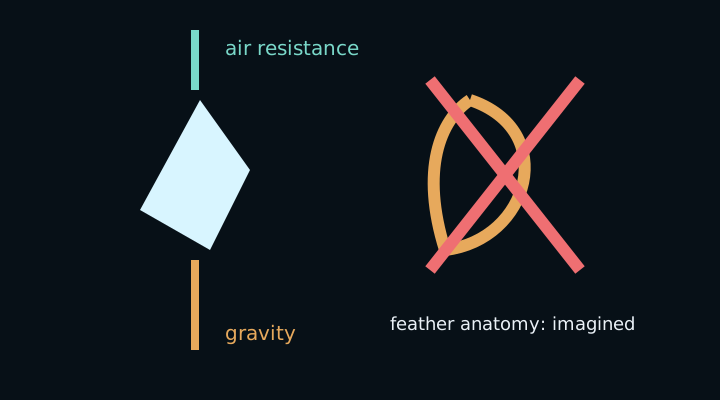
Temperature and humidity influence snow-crystal form. Air resistance and moving air can make descent wander.

Qualitative diagram of gravity and air resistance around an ice crystal contrasted with a feather-shaped snow form.
ICU explanatory schematic. No fall speed or scale is asserted.
What is borrowed
Snow forms vary and can follow irregular paths through moving air.
Where reality stops
Snow is ice, not feather; sustained buoyancy and glow are inventions.

UCAR/NSF NCAR snow crystals · NOAA/NWS turbulence

Prism Rain

Optical analogue only · real spectrum, impossible rain objects

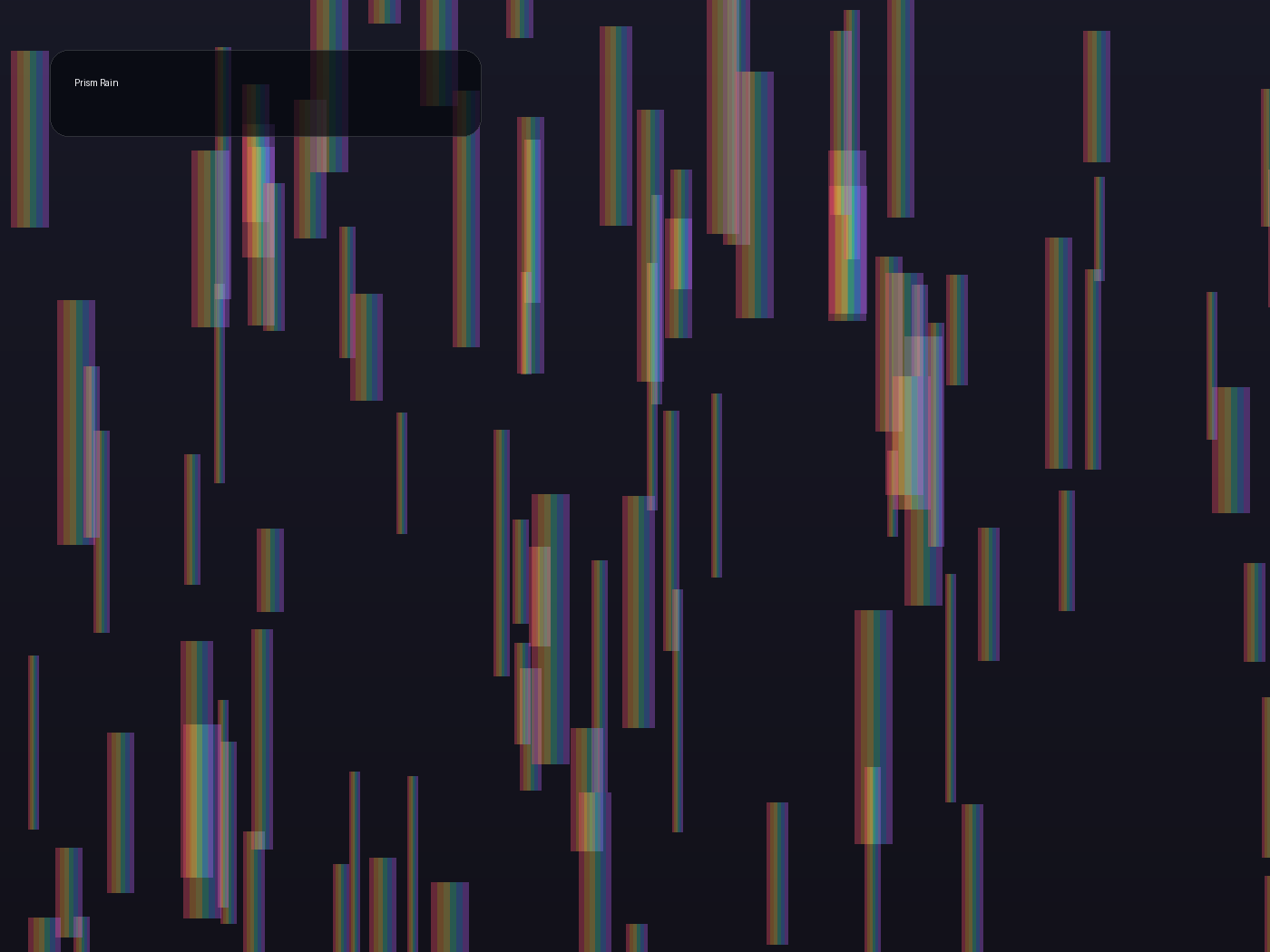
Fictional procedural artwork of translucent vertical prisms falling through a dark sky and breaking into spectral bands.
Imagined · ICU procedural art
Existing O037 artwork. Not a photograph of precipitation.

Imagined phenomenon

Rigid prisms falling as rain

Prisms fall through the sky and leave free-standing color bands near the ground.

Real mechanisms

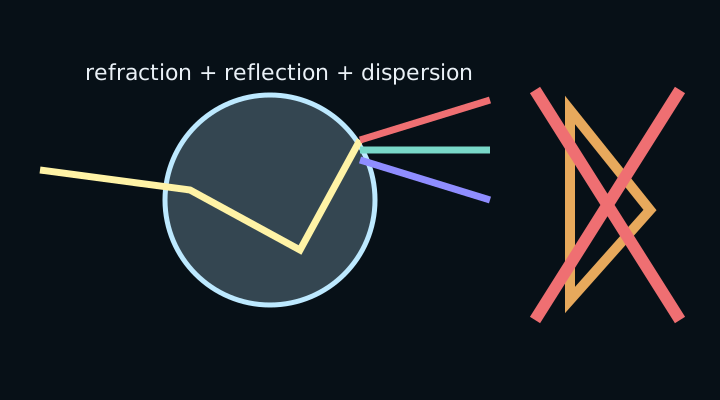
Refraction, internal reflection, and dispersion

Sunlight bends as it enters and exits droplets, reflects inside, and separates by wavelength before reaching an observer.

Simplified raindrop diagram showing a ray bending, reflecting, and leaving as separated colors beside a crossed-out falling prism.
One ray path is isolated for clarity; a rainbow needs many droplets and observer geometry.
What is borrowed
A visible spectrum can emerge from water-droplet optics.
Where reality stops
Rain stays liquid; drops deform and break rather than become rigid prisms.

Met Office rainbow optics · UCAR/NSF NCAR raindrop shape

Glass Fog

Impossible as depicted · real visibility and light cues

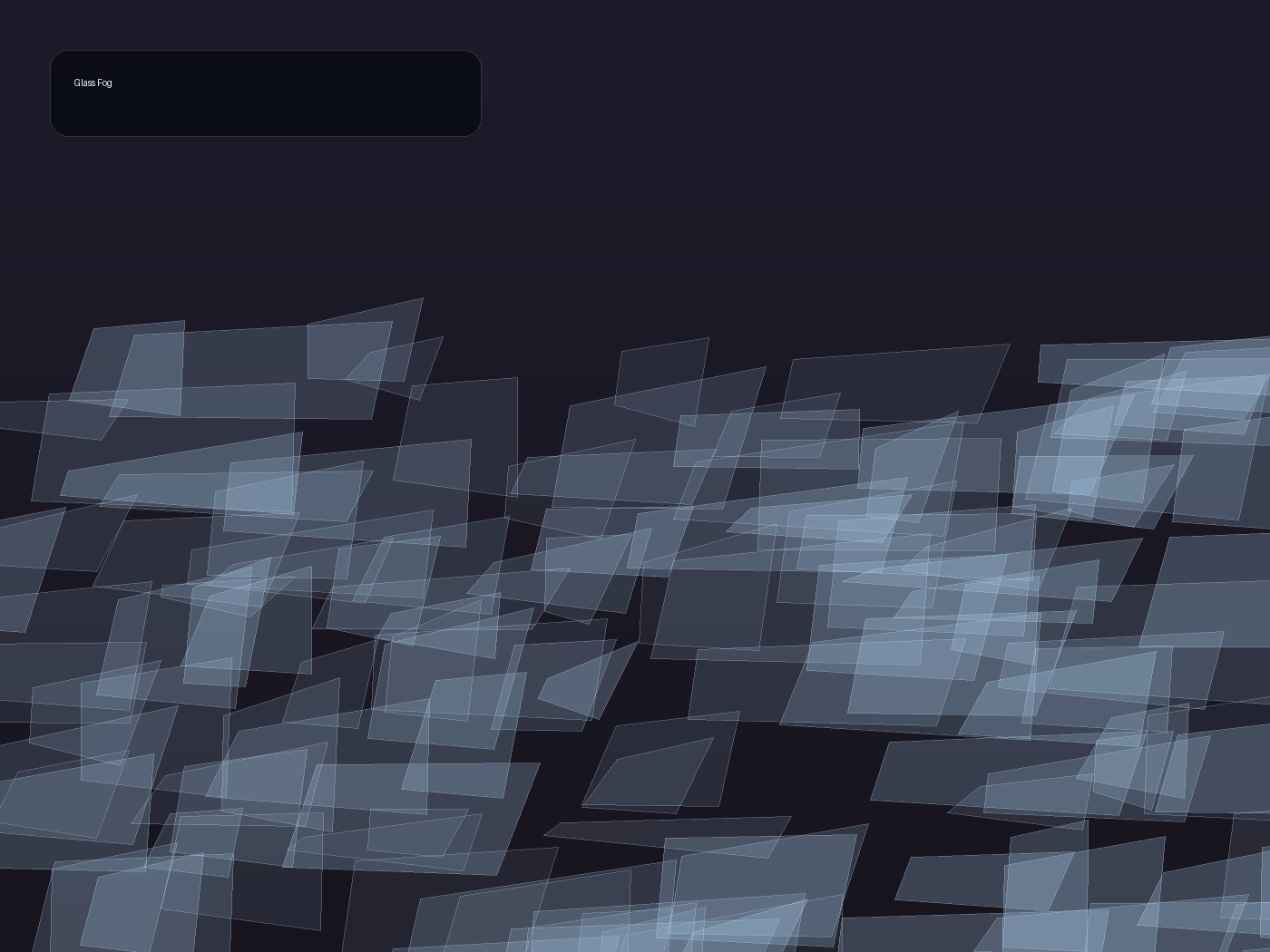
Fictional procedural artwork of translucent polygon panes accumulating as low fog and reflecting cold light.
Imagined · ICU procedural art
Existing O037 artwork. Not a photograph of fog or airborne glass.

Imagined phenomenon

Fog formed from suspended glass panes

Overlapping hard-edged panes create a low translucent field.

Real mechanisms

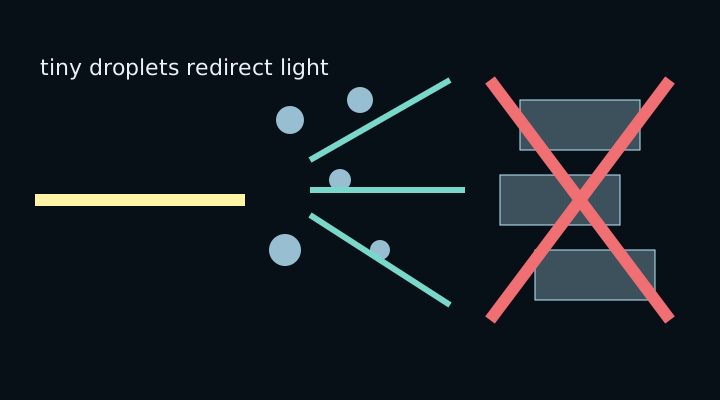
Suspended droplets and redirected light

Fog is a ground-level cloud of tiny suspended droplets. Dense droplets reduce distant contrast and redirect light.

Qualitative diagram of light scattering through tiny droplets beside crossed-out suspended glass panes.
Droplets and ray paths are symbolic, not measured or to scale.
What is borrowed
Low visibility and diffuse light are real fog cues.
Where reality stops
Macroscopic glass panes cannot act as a fog population or stay suspended that way.

Met Office fog · Met Office fogbow optics

Ribbon Lightning

Impossible as depicted · real electrical discharge

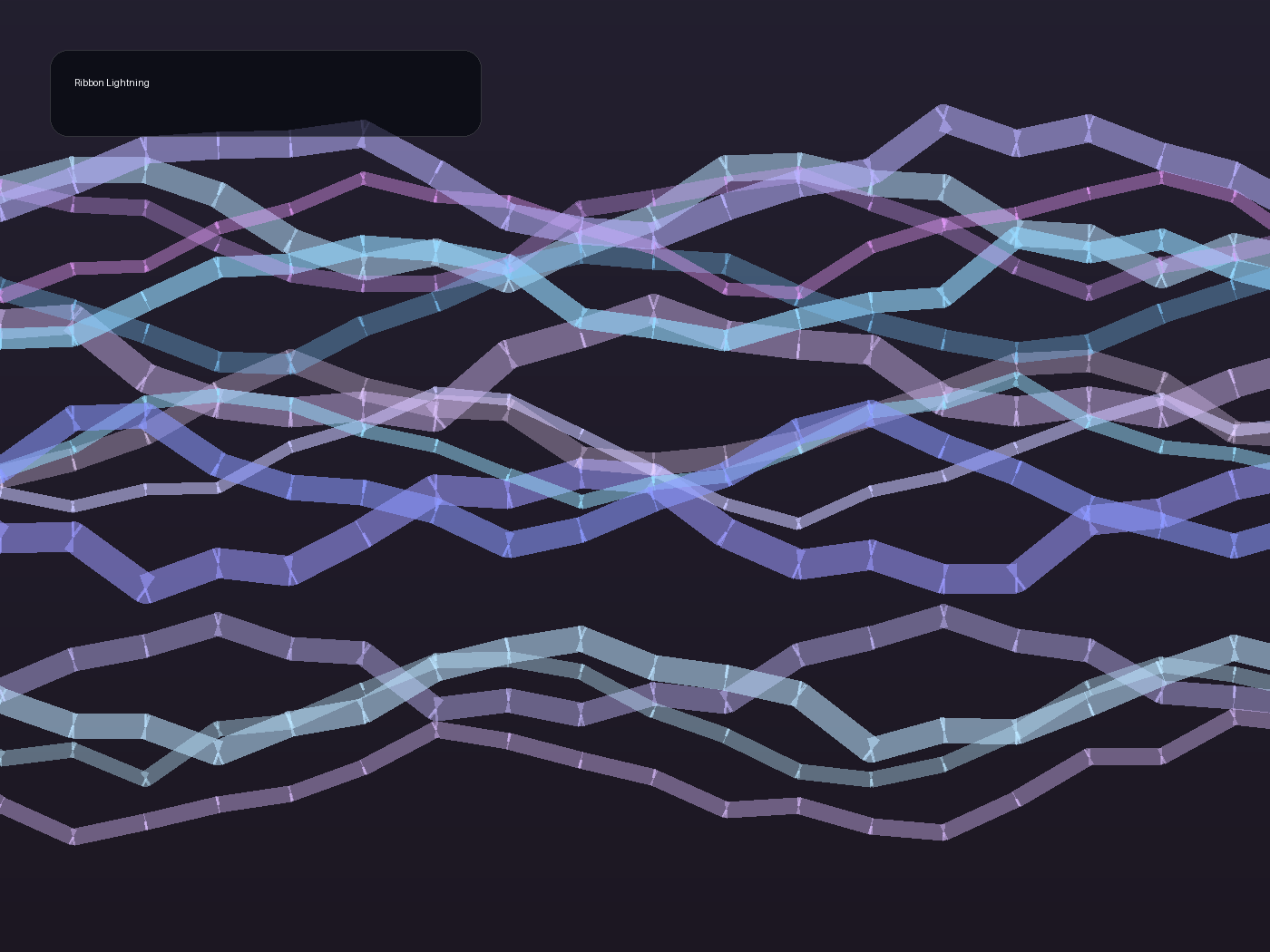
Fictional procedural artwork of broad folded ribbons of light arcing between cloud-like masses.
Imagined · ICU procedural art
Existing O037 artwork. Not lightning photography or safety guidance.

Imagined phenomenon

Lightning as a folded ribbon

A bright, smooth strip retains cloth-like folds through a storm.

Real mechanisms

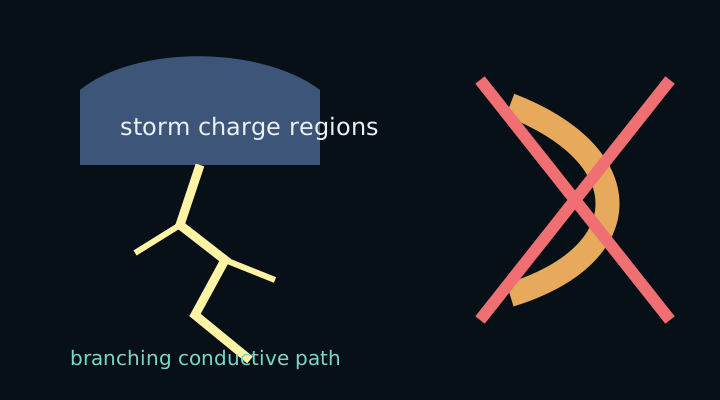
Charge separation and a branching channel

Storm motion and collisions help separate charge. A cloud-to-ground discharge can develop through a faint stepped leader and brighten along a conductive path.

Qualitative storm-charge and branching lightning-channel diagram beside a crossed-out broad ribbon.
This is not a strike forecast or safety diagram.
What is borrowed
A luminous electrical discharge is real.
Where reality stops
Lightning channels branch and change rapidly; they are not broad fabric-like surfaces.

NOAA/NWS electrification · NOAA/NWS lightning sequence

Pollen Aurora

Two mechanisms combined · impossible connection

Fictional procedural artwork of a diffuse aurora above a dark field while gold pollen-like points drift upward.
Imagined · ICU procedural art
Existing O037 artwork. Not an aurora or pollen observation.

Imagined phenomenon

Pollen rising into an aurora

Glowing pollen appears to move upward from a field and power the lights above.

Real mechanisms

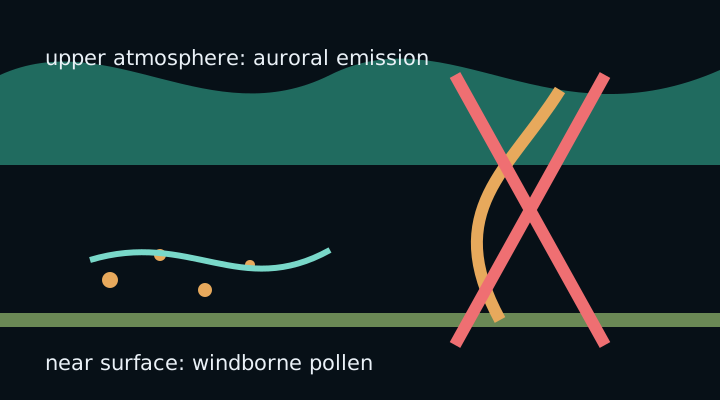
Auroral emission above, wind dispersal below

Auroral gases emit colored light high in the atmosphere after energetic-particle interactions. Wind can disperse pollen much lower down.

Qualitative layered diagram separating high auroral emission from low pollen dispersal, contrasted with an impossible connecting path.
Layer heights are symbolic; the comparison keeps the processes separate.
What is borrowed
Glow can appear in the upper atmosphere; wind can move pollen near the surface.
Where reality stops
Pollen does not power aurora or rise from a field into auroral regions as glowing particles.

NASA auroras · USGS pollen dispersal

Glossary

Turbulence
Irregular air motion with eddies and changing currents.
Refraction
Bending of light as it passes between materials.
Fog
A ground-level cloud of tiny suspended droplets.
Stepped leader
A faint branching lightning channel that advances in short steps.
Aurora
Light emitted when atmospheric gases are excited by energetic particles.
Advection
Transport of a substance by moving air.

Institutional sources

Sources reviewed September 13, 2026. These pages are linked and paraphrased. Their media and substantial text are not copied into this experience.

  1. NOAA/NWS: TurbulenceNOAA National Weather Service, Houston/Galveston Weather Forecast Office. Date not stated. Supports eddies and vertical currents.
  2. UCAR/NSF NCAR: What Makes Snowflakes Take Shape?Date not stated. Supports temperature and humidity as controls on snow-crystal form.
  3. Met Office: RainbowsDate not stated. Supports refraction, reflection, spectral separation, observer geometry, and fogbow diffraction.
  4. UCAR/NSF NCAR: The Shape of RaindropsDate not stated. Supports deformation and breakup of falling drops.
  5. Met Office: What is fog?Date not stated. Supports fog as suspended tiny droplets at ground level.
  6. NOAA/NWS: Thunderstorm ElectrificationDate not stated. Supports charge separation in thunderstorms.
  7. NOAA/NWS: What is Lightning?Date not stated. Supports stepped-leader and bright-channel sequence.
  8. NASA Science: AurorasPublished February 4, 2025. Supports atmospheric excitation and auroral colors.
  9. USGS: Paleoclimate ProxiesJanuary 31, 2022. Supports wind and other dispersal routes for pollen and spores.

Rights boundary

The six O037 images are existing ICU procedural artworks and are never presented as documentary evidence. The diagrams are task-local explanatory SVGs with no external image input. No external documentary image, video, audio, font, script, or map data was added.