Infinite Concept Universeresearch · make · build · play
Navigate the universe

Choose a direction.

Plan 5 treats the original eight worlds as historical origins, not mandatory top-level navigation.

ICUX-010 · source-visible night walks

Night is not one kind of dark.

Walk through 20 source-backed cases where moonlight, street lamps, signs, stored-energy pigments, living organisms and whole cities change what “night” means. Compare the light source, exposure context and ecological viewer without pretending one camera setting or one species sees them all the same way.

20 curated cases18 source records5 comparison familiesNo flashing effects
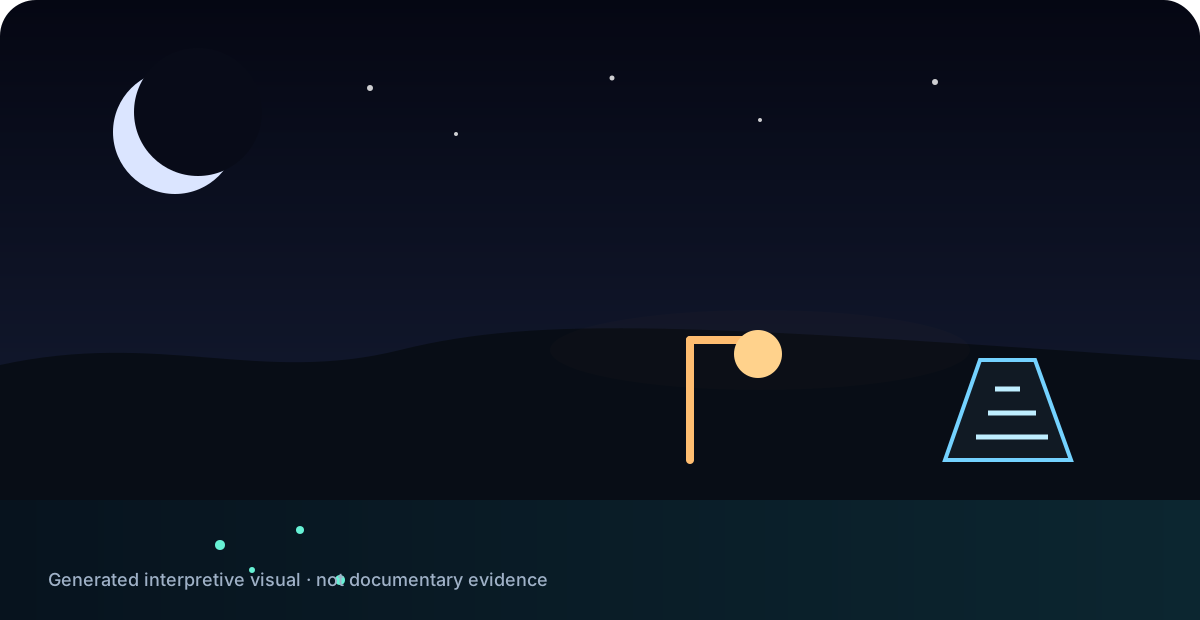
Generated interpretive diagram moving from moon and stars through a shielded lamp, reflected sign light and bioluminescent water.
Original interpretive diagram. It is not documentary evidence.
Truth boundary. Every card links to the institutional source used for its documentary context. The dark scene plates on this page are original generated visualizations, not photographs of the listed places, organisms or historical events. Exposure is presented as context, not as a calibrated reconstruction.

Signature experience

Take a source-visible night walk.

Use the previous/next controls or Left/Right Arrow keys. Each step keeps the source one action away and preserves a stable deep link when you open the full case.

1 / 20

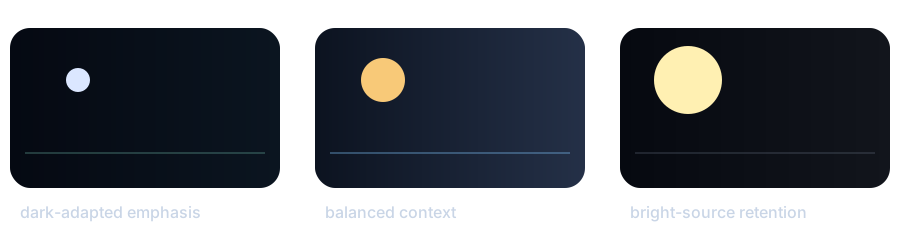
Generated three-part guide comparing dark-adapted emphasis, balanced context and bright-source retention.

Exposure context, not fake camera metadata. The labels describe what information a view emphasizes. They are not claims about f-stop, shutter speed, ISO, lux at the camera or what a particular animal sees unless the linked source explicitly provides that information.

Field collection

20 ways light changes night.

Filter by source family, then open a case for exact place/date/status fields and visible provenance.

20 cases shown
Generated interpretive scene
icux010-001

Moonlight on the John Muir Trail

Use this as the collection’s natural-light anchor: a trail scene where the visual system depends on dark adaptation rather than abundant artificial illumination.

Moonlightdocumented scene reference

Light: Moonlight

Place: John Muir Trail, Kings Canyon National Park, California, USA

Generated interpretive scene
icux010-002

Crescent Moon as an Illuminance Benchmark

A scale case rather than a single photograph: compare a crescent moon’s cited illuminance with the reach of an unshielded lamp in the same NPS explanation.

Moonlightdocumented measurement context

Light: Crescent moon

Place: NPS night-sky reference context, United States

Generated interpretive scene
icux010-003

Big Bend: Darkness as the Scene

This case deliberately centers what is absent: bright artificial light. It makes darkness a condition to compare, not a blank background.

Moonlightdocumented park reference

Light: Starlight, moonlight when present, airglow

Place: Big Bend National Park, Texas, USA

Generated interpretive scene
icux010-004

Stovepipe Wells Lighting Retrofit

A before-and-after management case: the goal is not zero light everywhere, but useful light placed and controlled so it does less unnecessary work.

Streetdocumented retrofit example

Light: Targeted outdoor electric lighting

Place: Stovepipe Wells, Death Valley National Park, California, USA

Generated interpretive scene
icux010-005

Las Vegas Street Grid from Orbit

From orbit, transport corridors and commercial concentrations become a luminous geometry. This case compares pattern, not a claim that brighter means better or safer.

Humandocumented orbital photograph

Light: Mixed urban electric lighting

Place: Las Vegas, Nevada, USA

Generated interpretive scene
icux010-006

Denver’s Mixed Street-Lamp Signatures

NASA uses Denver among examples where street pattern and lamp color help reveal layers of urban development at night.

Streetdocumented orbital comparison

Light: Mercury-vapor and sodium-vapor street lighting described by NASA

Place: Denver, Colorado, USA

Generated interpretive scene
icux010-007

Fishing Lights in the Java Sea

Hundreds of isolated points off the coast show how a mobile working light source can transform what otherwise reads as dark sea.

Humandocumented orbital scene

Light: High-intensity fishing-vessel lamps

Place: Java Sea, north of Surabaya, Indonesia

Generated interpretive scene
icux010-008

Yellow Sea: City Glow, Lightning and Fishing Fleets

One scene contains several kinds of night light at once, making it useful for learning not to treat every bright point as the same phenomenon.

Humandocumented orbital scene

Light: Urban glow, lightning, fishing floodlights

Place: Yellow Sea / eastern Asia

Generated interpretive scene
icux010-009

Cape Hatteras: The Brightest Horizon Problem

The same concept of “brightest direction” can have very different consequences for people and wildlife. This case foregrounds the ecological viewer.

Ecologydocumented wildlife guidance

Light: Moon/starlight on ocean plus artificial beachfront lighting

Place: Cape Hatteras National Seashore, North Carolina, USA

Generated interpretive scene
icux010-010

Migratory Birds and Lit Buildings

This case reframes the city skyline as habitat-adjacent infrastructure: when, where and how light is used can matter to migrating birds.

Ecologydocumented wildlife guidance

Light: Building and exterior artificial lighting

Place: Urban migration corridors, United States

Generated interpretive scene
icux010-011

Dubuque Gas Station, 1940

A historical night street where the service station reads as an island of light, useful for comparing concentrated task lighting with darker surroundings.

Streetdocumented historical photograph

Light: Early electric forecourt and street lighting

Place: Dubuque, Iowa, USA

Generated interpretive scene
icux010-012

Hollywood Neon Theater, 1942

Neon turns written information into emitted light. Here the sign is not merely illuminated; the sign itself becomes the light source.

Luminousdocumented historical photograph record

Light: Neon electric signs

Place: Hollywood, Los Angeles, California, USA

Generated interpretive scene
icux010-013

Theater District Electric Signs, 1957

A dense sign field shows how artificial light can structure attention, wayfinding and visual hierarchy in a human night environment.

Luminousdocumented catalog record; linked media not redistributed

Light: Neon and electric advertising signs

Place: New York City, New York, USA

Generated interpretive scene
icux010-014

Broadway Neon, Nashville, 2021

A contemporary counterpart to the mid-century sign cases, useful for tracing continuity in night-time commercial light as a cultural material.

Luminousdocumented catalog record; linked media not redistributed

Light: Neon and mixed commercial signage

Place: Broadway, Nashville, Tennessee, USA

Generated interpretive scene
icux010-015

Retroreflective Road Signs in Headlights

A useful boundary case: the sign can appear to glow at night, but the material is returning incident headlamp light rather than generating its own light.

Luminousdocumented engineering reference

Light: Vehicle headlamps returned toward the source by retroreflective material

Place: Roadway reference context, United States

Generated interpretive scene
icux010-016

Phosphorescent Paint After the Lights Go Out

Smithsonian conservators used afterglow duration and instrumental analysis to investigate a phosphorescent pigment. The case distinguishes persistent afterglow from fluorescence.

Luminousdocumented conservation analysis

Light: Stored-energy phosphorescent afterglow

Place: Smithsonian American Art Museum conservation context, Washington, D.C., USA

Generated interpretive scene
icux010-017

Bioluminescence in the Deep Ocean

Night light is not only astronomical or technological. In much of the ocean, living organisms make light chemically inside otherwise dark habitats.

Luminousdocumented science reference

Light: Biochemical light produced by organisms

Place: Marine habitats, including deep ocean

Generated interpretive scene
icux010-018

Mosquito Bay’s Dinoflagellate Glow

A place-specific biological-light case, paired with a careful boundary: conditions vary, and the generated visualization does not claim to reproduce a particular night’s observation.

Luminousdocumented place/science reference

Light: Dinoflagellate bioluminescence

Place: Mosquito Bay, Vieques, Puerto Rico

Generated interpretive scene
icux010-019

Skyglow at a Protected-Land Horizon

Distance does not make artificial light irrelevant. This case focuses on the atmosphere as the medium that spreads urban light into a darker landscape.

Ecologydocumented science/management reference

Light: Distant artificial light scattered in the atmosphere

Place: Protected-land reference context, United States

Generated interpretive scene
icux010-020

One Unshielded Lamp Against the Night

The collection closes at human scale: a single fixture can be visually dominant at night. Direction and shielding change what the lamp illuminates and what it spills into.

Streetdocumented measurement context

Light: Unshielded outdoor lamp

Place: NPS night-lighting reference context, United States

Compare

Put three night conditions side by side.

Comparison is descriptive, not a ranking. It keeps light source, exposure context, place and ecology visible together.

Choose up to three “Compare” controls in the case cards.

Method

What this collection does and does not claim.

Documentary

Sources stay visible.

Historical dates, named places, scientific context and wildlife claims come from linked institutional records. A card can be source-backed without redistributing the source’s media.

Interpretive

Generated scenes are labeled.

The visuals are deliberately abstract. They help compare light relationships but never masquerade as archival photographs, field observations or calibrated simulations.

Ecological

The viewer can change.

Human dark adaptation is not treated as a proxy for turtles, birds or marine organisms. Ecological context is shown only where the source supports it.

Local continuity

Carry your walk without an account.

These controls manage only ICUX-010 view preferences and comparisons in this browser. “Save to My Universe” continues to use ICU’s existing workbench store.

Recovery rule. Invalid, malformed or future-version state is never silently written over valid browser records. When possible, the rejected/raw state is retained in a task-local recovery key before a safe default is used.

Source register

Follow every documentary anchor.

External records open in a new tab. No external documentary image, font, video or audio byte is copied into this candidate.

government explainer

How Light Works — Night Skies

NPS explains dark-adapted vision, visible-light sensitivity, natural sky brightness and illuminance context for moonlight and distant lamps.

Open source ↗

government park interpretation

The Darkness That Refreshes

NPS describes Big Bend's unusually dark measured night sky and the visitor experience of natural darkness.

Open source ↗

government lighting guidance

Outdoor Lighting Principles — Night Skies

NPS documents shielding, timing, intensity and color considerations for outdoor lighting, including sensitive environments.

Open source ↗

government wildlife guidance

Sea Turtles — Cape Hatteras National Seashore

NPS explains how natural horizon light cues and artificial beachfront lighting affect sea turtle hatchling orientation.

Open source ↗

government wildlife guidance

Threats to Birds: Collisions (Nighttime Lighting)

USFWS describes attraction and disorientation risks from artificial night lighting for migrating birds, especially under low cloud or fog.

Open source ↗

government science explainer

What is bioluminescence?

NOAA defines bioluminescence as light produced and emitted by living organisms through chemical reactions and summarizes its ecological functions.

Open source ↗

government educational source

The Ocean is Glowing with Microorganisms

NOAA identifies Mosquito Bay, Vieques, as a place where dinoflagellates produce visible bioluminescence at night.

Open source ↗

government Earth observation

Las Vegas at Night

NASA documents ISS photograph ISS026-E-6255 from 2010-11-30 and describes the contrast between the illuminated street grid and surrounding desert darkness.

Open source ↗

government Earth observation

Cities at Night: The View from Space

NASA discusses how street patterns and lighting colors can distinguish urban areas, including mercury-vapor and sodium-vapor lighting patterns in North American cities.

Open source ↗

government Earth observation

Just Another Night Over Java

NASA describes urban lights, fishing-vessel lights, gas flares and lightning visible in a 2014 nighttime view of eastern Java and the Java Sea.

Open source ↗

government Earth observation

Yellow Sea Night Lights

NASA describes an October 2021 ISS view containing urban glow, lightning and high-powered fishing-vessel lights across the Yellow Sea region.

Open source ↗

public-domain documentary record

Gas station at night. Dubuque, Iowa

John Vachon's April 1940 FSA/OWI photograph documents a brightly illuminated gas station within a much darker urban street scene.

Open source ↗

public-domain documentary record

Hollywood, California. Neon signs at the famous Earl Carroll theater

Russell Lee's April 1942 photograph records concentrated neon theater lighting in Hollywood.

Open source ↗

documentary catalog record

Night view of street with theaters and neon signs, New York City

The LOC catalog dates this theater-and-electric-sign streetscape to July 1957 and describes the illuminated signage visible at night.

Open source ↗

documentary catalog record

Neon signs along Broadway, Nashville

The LOC record dates Carol M. Highsmith's Broadway neon-sign photograph to 2021-11-13.

Open source ↗

government roadway guidance

Nighttime Visibility Sign Retroreflectivity — FAQ

FHWA explains retroreflectivity as engineered return of incident light toward its source, making signs and markings appear bright in headlamp illumination.

Open source ↗

museum conservation article

A Conservator Finds Art in the Dark

Smithsonian conservation staff describe analysis of a phosphorescent artwork and distinguish persistent phosphorescent afterglow from fluorescence.

Open source ↗

government science explainer

Light Pollution — Night Skies

NPS defines glare, light trespass and skyglow and discusses how artificial night lighting affects dark adaptation and protected natural lightscapes.

Open source ↗

Continue through ICU. Explore Signal Gardens · Night Room, the glow-in-the-dark materials explainer, or return to Collections. This experience does not certify any real-world night route as safe to visit.

Documentary anchors