
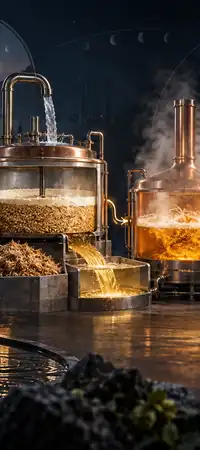



material handling
Raw Material Staging
The pre-brewhouse handling layer in which brewing materials are staged for use without changing their canonical ingredient identity.
History, science, place, design, flavor, and brewing systems in one connected world.
Process map
Conceptual sequence only; it is not an operating recipe, time/temperature schedule, or safety instruction.
Generation B · Process & Fermentation
A causal process map that keeps ingredients, organisms, equipment, recipes, chemistry, and serving systems as separate identities. The foundation explains what connects without turning process pages into universal operating instructions.
Causal thread
Milling → mashing → separation → boil/hot-side handling → cooling → fermentation branch → conditioning → optional clarification → packaging → service. Dealcoholization is modeled as a separate optional post-fermentation branch.
Process phase 010
Stage brewing materials before conversion begins. Ingredient identity remains separate from storage, conveying, and plant systems.
material handling
The pre-brewhouse handling layer in which brewing materials are staged for use without changing their canonical ingredient identity.
Process phase 020
Reduce particle size and expose grain structure. The process is not a mill model, gap specification, or recipe instruction.
size reduction
Mechanical size reduction that exposes grain structure for subsequent extraction while remaining distinct from mashing itself.
Process phase 030
Create soluble extract through water, grist, enzymes, and process conditions. BEU describes the causal process without prescribing a mash program.
enzymatic conversion
The water-and-grist conversion stage in which malt enzymes and process conditions make soluble extract and fermentable carbohydrates available in wort.
Process phase 040
Separate wort from spent grain solids. The process remains distinct from vessel engineering and runoff instructions.
solid liquid separation
A solid-liquid separation stage that separates soluble wort from the spent-grain bed after mashing.
Process phase 050
Apply thermal treatment to wort and support several physical/chemical changes. No universal duration, evaporation target, or kettle setup is implied.
thermal treatment
Thermal treatment of wort associated with concentration, protein changes, volatile stripping, sanitation effects, and hop chemistry when hops are present.
Process phase 055
Introduce hop material in a defined process context. Hop amount, timing, product form, and recipe targets remain separate data.
ingredient addition
A hot-side hop-use process whose outcomes depend on hop material, timing, wort conditions, and the surrounding boil.
Process phase 070
Remove heat before fermentation. No target temperature or heat-exchanger configuration is prescribed.
heat exchange
Heat removal that transitions hot wort toward conditions suitable for the chosen fermentation system.
Process phase 080
Model microbial conversion without duplicating organism/culture identities. Yeast and microbes stay Ingredient Genome nodes; process conditions remain separate from organism identity.
microbial conversion
A biological fermentation process in which brewing yeast metabolizes wort constituents and forms ethanol, carbon dioxide, and many flavor-active metabolites.
microbial conversion
A biological fermentation process associated with lager brewing cultures, kept distinct from the microbial species/culture identities that perform it.
Process phase 090
Represent post-primary-fermentation maturation and composition change. No fixed time/temperature program is asserted.
maturation
Post-fermentation conditioning during which beer composition and sensory-active compounds can continue to change before final clarification or packaging.
Process phase 100
Separate suspended material at hot-side or finished-beer stages. Hot-trub separation and finished-beer filtration remain distinct process identities.
physical separation
A physical clarification process used for some beers to remove suspended material and support clarity or stability objectives.
physical separation
A post-boil physical separation step used to remove hot trub and insoluble hop material before cooled wort enters fermentation.
Process phase 110
Transfer beer into a package while preserving beer/package/equipment identity boundaries. No filling pressure, sanitation procedure, or package specification is prescribed.
packaging transfer
A packaging-transfer process that moves beer into a keg system while preserving the distinction between beer, package, and filling equipment.
Process phase 120
Represent delivery from package/system to point of service. No gas balance, pressure setting, line-cleaning, or pouring instruction is encoded as generic advice.
dispense
The serving process in which packaged draught beer moves through a balanced dispense system toward the point of service.
Process phase 130
Represent optional post-fermentation alcohol-reduction processes. Technology tradeoffs, legal definitions, labeling rules, and operating parameters stay source/jurisdiction specific.
membrane separation
A membrane-based post-fermentation process that can reduce ethanol while attempting to retain other beer constituents, with process tradeoffs that depend on system and conditions.
Cross-world graph
Only sourced BEU007 edges appear. Missing links mean “not asserted yet,” never “unrelated.”
Pilsner malt connects to milling and mashing; brewing water connects to mashing; yeast identities connect to fermentation without being duplicated as processes.
Ale and lager fermentation connect to ethanol formation. Maturation connects to diacetyl change, and reverse-osmosis dealcoholization connects to ethanol reduction.
Hot-side hopping connects to bitterness, while representative lager and ale style concepts connect to their broad fermentation process families.