Infinite Concept Universeresearch · make · build · play
Navigate the universe

Choose a direction.

Plan 5 treats the original eight worlds as historical origins, not mandatory top-level navigation.

ICUX-009 · evidence-aware atlas

Weather & Atmosphere Atlas

Match temperature, light and moisture contexts to 24 atmospheric phenomena — then inspect what the match can and cannot tell you. This browser explains observation conditions. It never forecasts current weather.

24 source-backed entriesNo live weather feedNo location requiredOriginal ICU diagrams
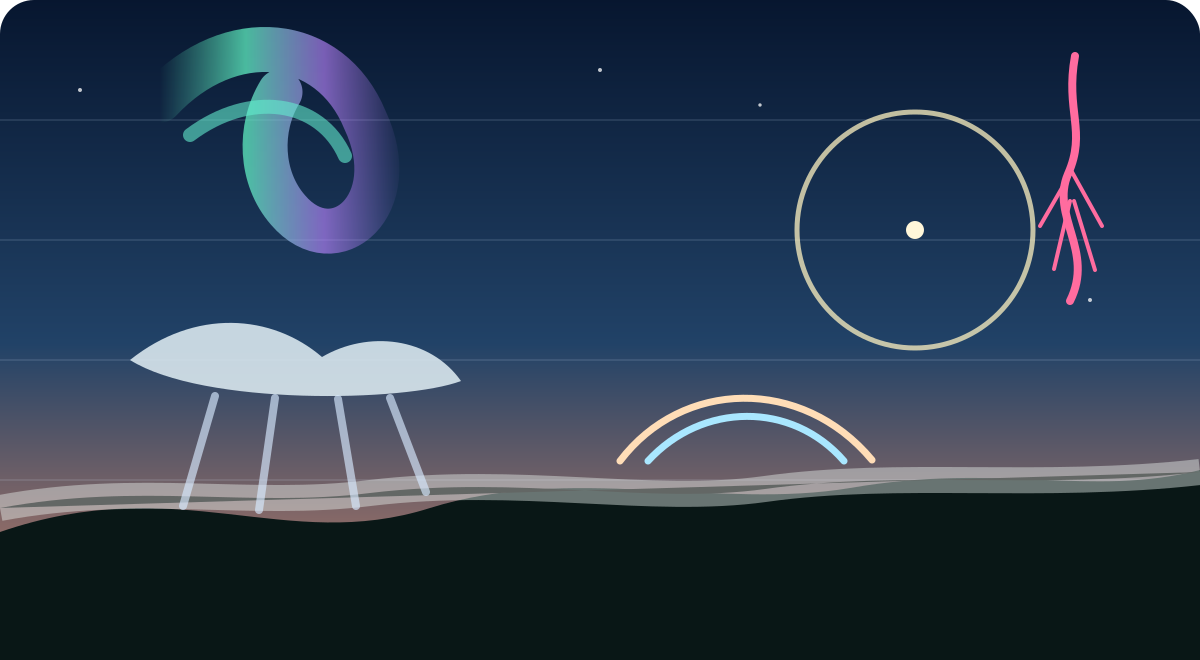
Interpretive atmosphere cross-section showing fog, precipitation, a halo, auroral light and a sprite above a dark horizon.
ICU-authored explanatory vector. It is an interpretation, not a photograph, satellite capture, or source evidence.

How to read the atlas

Observation context, not prediction

The three selectors describe conditions commonly associated with seeing a phenomenon. They are intentionally coarse. A match means “worth comparing,” not “this will happen.” Temperature context refers to the atmospheric layer that matters for the phenomenon, which may be far above the surface.

Weather safety boundary. This atlas is educational. For lightning, severe wind, poor visibility or other hazards, use official local warnings and guidance rather than this page.

24 of 24 phenomena

Radiation fog

Fog

A ground-hugging white or gray layer that can be patchy, with clearer air above when the fog is shallow.

surface coolingdark nighttwilightmoist near-surface air
Inspect evidence-aware entry
Phenomenon
Radiation fog
Required conditions
Clear or mostly clear overnight conditions, light wind, moist near-surface air, and enough ground cooling for air near the surface to reach saturation.
Observation scope
Common near the ground overnight into morning, especially in sheltered valleys and near moist surfaces. This describes formation context, not a visibility forecast.
Visual cues
A ground-hugging white or gray layer that can be patchy, with clearer air above when the fog is shallow.
Photo context
Dawn can reveal the top edge and depth of the fog. Use a fixed landmark for scale and never enter low-visibility traffic areas just to photograph it.
Evidence limits
Ground cooling and moisture favor radiation fog but do not guarantee it; local wind, terrain and mixing matter. The atlas does not estimate onset, density or burn-off time.

Advection fog

Fog

A broad, low cloud layer that can slide across terrain or shoreline rather than simply pooling in place.

temperature not diagnosticlight not diagnosticmoist near-surface airfog / mist droplets
Inspect evidence-aware entry
Phenomenon
Advection fog
Required conditions
Moist air moving across a colder surface so the near-surface air cools to saturation; unlike classic radiation fog, wind can be part of the setup.
Observation scope
Often seen in coastal or other settings where moist air crosses a colder land or water surface. It can move with the low-level flow.
Visual cues
A broad, low cloud layer that can slide across terrain or shoreline rather than simply pooling in place.
Photo context
Side lighting and an elevated viewpoint can show the fog bank's edge and motion. Avoid treating motion alone as proof of the fog type.
Evidence limits
Appearance cannot reliably distinguish every fog mechanism. Confirming advection fog requires meteorological context beyond a photograph.

Steam fog

Fog

Low, curling plumes or tendrils that look like steam rising from the water surface.

cold air over warmer waterlight not diagnosticfog / mist droplets
Inspect evidence-aware entry
Phenomenon
Steam fog
Required conditions
Much colder air moving over relatively warmer water or another moisture source, adding water vapor that condenses into the cold air.
Observation scope
Most recognizable immediately above open water during cold-air outbreaks; the wisps are shallow and tied to the moisture source.
Visual cues
Low, curling plumes or tendrils that look like steam rising from the water surface.
Photo context
Backlighting can make the shallow plumes visible. Keep distance from cold water, ice edges and slippery shorelines.
Evidence limits
The visible plume shows condensation but does not quantify air-water temperature difference. At very low temperatures ice particles can also occur.

Virga

Precipitation

Feathery streaks hanging from the cloud base that taper, curve or disappear before the surface.

temperature not diagnosticdaylightlow Sundry air below cloud
Inspect evidence-aware entry
Phenomenon
Virga
Required conditions
Precipitation falling from a cloud into air dry or warm enough for the drops or ice particles to evaporate or sublimate before reaching the ground.
Observation scope
Visible beneath many cloud types as precipitation shafts that fade aloft. It is an observation of falling hydrometeors, not a claim about surface rainfall.
Visual cues
Feathery streaks hanging from the cloud base that taper, curve or disappear before the surface.
Photo context
Low-angle sunlight can emphasize streaks and curvature. Include the cloud base and horizon so the failure to reach the ground is visually legible.
Evidence limits
A photo cannot establish whether all precipitation evaporated everywhere under the cloud. Virga can also be associated with downdrafts; this atlas gives no aviation hazard guidance.

Lenticular clouds

Cloud form

Smooth lens, saucer or stacked-pancake shapes, often aligned near or downwind of high terrain.

temperature not diagnosticdaylightlow Sunthin liquid-water cloud
Inspect evidence-aware entry
Phenomenon
Lenticular clouds
Required conditions
Stable moist air flowing across a mountain or other barrier, producing standing waves in which cloud forms near the wave crest.
Observation scope
Most often associated with terrain-induced atmospheric waves. The cloud can appear nearly stationary even while air flows through it.
Visual cues
Smooth lens, saucer or stacked-pancake shapes, often aligned near or downwind of high terrain.
Photo context
A wide frame including the terrain helps establish orographic context. Time-lapse can show air moving through a cloud that seems fixed in place.
Evidence limits
A lens shape alone is not enough to reconstruct wind or stability profiles. This entry does not infer turbulence at a specific location.

Mammatus

Cloud form

Rows or clusters of rounded, drooping pouches hanging from a cloud base or anvil.

ice / freezing alofttemperature not diagnosticdaylightlow Sun
Inspect evidence-aware entry
Phenomenon
Mammatus
Required conditions
Pouch-like cloud features forming on the underside of a parent cloud, commonly but not exclusively associated with thunderstorm anvils.
Observation scope
A supplementary cloud feature. Mammatus can accompany severe or non-severe storms and is not itself a tornado indicator.
Visual cues
Rows or clusters of rounded, drooping pouches hanging from a cloud base or anvil.
Photo context
Oblique low-angle light can reveal texture. Photograph only from a safe location and use official warnings for storm risk.
Evidence limits
Mammatus appearance does not determine storm severity. The atlas deliberately avoids turning cloud shape into a hazard forecast.

Shelf cloud

Cloud form

A long wedge-shaped leading edge with turbulent or wind-torn underside; the cloud slopes away from the rain-cooled air.

temperature not diagnosticdaylightlow Sunthunderstorm cloud / outflow
Inspect evidence-aware entry
Phenomenon
Shelf cloud
Required conditions
A gust front or outflow boundary lifting warm moist air along the leading edge of a thunderstorm or, less commonly, a cold front.
Observation scope
A low, horizontal arcus cloud attached to the parent cloud and marking the leading edge of outflow.
Visual cues
A long wedge-shaped leading edge with turbulent or wind-torn underside; the cloud slopes away from the rain-cooled air.
Photo context
A wide horizontal frame helps separate the attached shelf from a detached roll cloud. Do not position yourself in a storm's path for a photograph.
Evidence limits
Shelf clouds can accompany strong straight-line winds, but appearance alone does not measure wind speed or predict tornadoes. Use official warnings for hazards.

Fallstreak hole

Cloud form

A circular or elongated hole punched through a cloud sheet, often with a wispy fallstreak descending from the center.

ice / freezing aloftdaylightthin liquid-water cloudice crystals
Inspect evidence-aware entry
Phenomenon
Fallstreak hole
Required conditions
A supercooled cloud layer in which part of the liquid water freezes, encouraging surrounding droplets to convert to ice and fall out.
Observation scope
Usually seen in a thin mid-level cloud deck as a localized opening with falling ice crystals beneath or within it.
Visual cues
A circular or elongated hole punched through a cloud sheet, often with a wispy fallstreak descending from the center.
Photo context
Use a wide view to show the surrounding uniform cloud layer and a tighter view for the central fallstreak. Aircraft can sometimes trigger the ice formation, but not every hole is attributable from a photo.
Evidence limits
Visual evidence rarely identifies the exact triggering process. The entry describes the accepted microphysical pattern without assigning a cause to a particular observation.

Contrail

Cloud form

A narrow bright line behind an aircraft that may fade quickly or persist, broaden and shear with the wind.

ice / freezing aloftdaylightlow Sunice crystals
Inspect evidence-aware entry
Phenomenon
Contrail
Required conditions
Aircraft exhaust mixing with sufficiently cold, moist upper-level air so water vapor condenses and freezes into an ice-crystal cloud.
Observation scope
A human-caused line cloud at aircraft altitude. Persistence and spreading depend strongly on upper-level humidity and wind.
Visual cues
A narrow bright line behind an aircraft that may fade quickly or persist, broaden and shear with the wind.
Photo context
Include the aircraft only when safely visible; a sequence over minutes is more informative than a single frame for persistence and drift.
Evidence limits
A photograph does not reveal exact humidity or altitude and cannot establish broader climate effect for that individual trail.

Dust devil

Wind

A narrow rotating column of dust rising from a hot, dry surface, often under mostly clear sky.

strong surface heatingdaylightdry heated surface
Inspect evidence-aware entry
Phenomenon
Dust devil
Required conditions
Strong surface heating in generally fair weather creating a small, rapidly rotating column of air that becomes visible when it lifts dust or debris.
Observation scope
A short-lived convective vortex not attached to a thunderstorm. Most are small, though size and intensity vary.
Visual cues
A narrow rotating column of dust rising from a hot, dry surface, often under mostly clear sky.
Photo context
Use distance and a long focal length. Do not approach the vortex or stand where blowing debris could reach you.
Evidence limits
Visible dust marks the airflow but does not provide wind speed or damage potential. Dust devils are distinct from tornadoes despite superficial rotation.

Rainbow

Optics

A colored arc opposite the Sun, red on the outer edge of the primary bow and violet toward the inner edge.

temperature not diagnosticSun behind observerrain / suspended droplets
Inspect evidence-aware entry
Phenomenon
Rainbow
Required conditions
Sunlight entering suspended water droplets while the Sun is behind the observer; refraction, internal reflection and dispersion return separated colors toward the observer.
Observation scope
An observer-dependent optical geometry rather than a fixed object in one location. The bow's apparent position changes with the viewer.
Visual cues
A colored arc opposite the Sun, red on the outer edge of the primary bow and violet toward the inner edge.
Photo context
Keep the Sun behind you and include the rain shaft or dark cloud backdrop when possible. A polarizer can alter contrast, so note it when documenting evidence.
Evidence limits
The filters describe viewing geometry, not the likelihood of a bow. Droplet size, Sun elevation and intervening cloud affect visibility.

22° halo

Optics

A pale circular ring with the inner edge often sharper and slightly reddish; the sky inside can look darker by contrast.

ice / freezing aloftdaylightMoon / bright point sourceice crystals
Inspect evidence-aware entry
Phenomenon
22° halo
Required conditions
Sunlight or moonlight refracting through hexagonal ice crystals, commonly in cirrus or cirrostratus cloud, producing the most common halo radius near 22 degrees.
Observation scope
A large ring centered on the Sun or Moon. Surface air need not be below freezing because the relevant ice crystals are aloft.
Visual cues
A pale circular ring with the inner edge often sharper and slightly reddish; the sky inside can look darker by contrast.
Photo context
Use a wide lens and block the solar disk with a solid object when framing a solar halo; never stare at the Sun through an optical viewfinder.
Evidence limits
A visible ring supports ice-crystal optics but does not reveal cloud altitude, crystal population or future weather with certainty.

Sun dog (parhelion)

Optics

One or two bright mock suns, often with reddish color on the Sun-facing side and fainter blue outward.

ice / freezing aloftdaylightlow Sunice crystals
Inspect evidence-aware entry
Phenomenon
Sun dog (parhelion)
Required conditions
Sunlight refracting through plate-like hexagonal ice crystals, often in cirrus or very cold low-level diamond dust.
Observation scope
Bright spots typically about 22 degrees to the left and right of the Sun at the same elevation, frequently associated with a 22-degree halo.
Visual cues
One or two bright mock suns, often with reddish color on the Sun-facing side and fainter blue outward.
Photo context
Low Sun angles often make sun dogs easier to notice. Shield the solar disk and avoid direct optical viewing of the Sun.
Evidence limits
The apparent spacing is geometric, but shape and color vary with crystal orientation. A photograph alone cannot identify the full crystal population.

Light pillar

Optics

A narrow luminous column vertically aligned with the source, sometimes tinted by the source color.

ice / freezing aloftlow SunMoon / bright point sourceice crystals
Inspect evidence-aware entry
Phenomenon
Light pillar
Required conditions
Plate-like ice crystals oriented roughly horizontally so light from the Sun, Moon or a bright artificial source reflects toward the observer.
Observation scope
An apparent vertical column above or below a light source; the pillar is a line-of-sight collection of reflections, not a physical beam extending upward.
Visual cues
A narrow luminous column vertically aligned with the source, sometimes tinted by the source color.
Photo context
Night scenes benefit from protecting highlights and recording the actual light source when possible. Avoid implying a pillar is a laser-like beam.
Evidence limits
Pillar extent depends on crystal heights and orientations; a single image cannot reconstruct that distribution.

Atmospheric corona

Optics

One or more tight colored rings, commonly easiest to see around the Moon; blue-violet is toward the inside and red outward.

temperature not diagnosticMoon / bright point sourcedaylightthin liquid-water cloud
Inspect evidence-aware entry
Phenomenon
Atmospheric corona
Required conditions
Light diffracting around many small, similarly sized droplets in a thin cloud or mist, producing compact colored rings around the Sun or Moon.
Observation scope
A small-radius optical effect close to the light source, distinct from the much larger 22-degree ice-crystal halo.
Visual cues
One or more tight colored rings, commonly easiest to see around the Moon; blue-violet is toward the inside and red outward.
Photo context
Expose for the bright Moon or shield the Sun. Include enough sky to show that the rings are small compared with a halo.
Evidence limits
Ring size relates to droplet size, but casual photographs are not calibrated microphysical measurements. Do not infer precipitation timing from this atlas.

Glory

Optics

A compact rainbow-like halo around the head of a shadow, sometimes paired with a large Brocken spectre.

temperature not diagnosticSun behind observerfog / mist dropletsthin liquid-water cloud
Inspect evidence-aware entry
Phenomenon
Glory
Required conditions
Sunlight interacting with tiny cloud or fog droplets while the observer looks toward the antisolar direction, often from above a cloud or mist layer.
Observation scope
Colored concentric rings centered on the antisolar point, frequently surrounding the observer's shadow when it falls onto cloud or fog.
Visual cues
A compact rainbow-like halo around the head of a shadow, sometimes paired with a large Brocken spectre.
Photo context
High viewpoints or aircraft windows can provide the geometry. Keep the Sun behind you and avoid leaning or climbing into unsafe positions for the angle.
Evidence limits
Glory formation involves wave-optical scattering; simple ray descriptions are incomplete. The atlas identifies the visible pattern without estimating droplet size.

Fogbow

Optics

A broad white arc, often with a faint red outer edge and bluish inner edge.

temperature not diagnosticSun behind observerfog / mist droplets
Inspect evidence-aware entry
Phenomenon
Fogbow
Required conditions
Sunlight behind the observer and a screen of very small fog droplets in the antisolar direction.
Observation scope
A rainbow-like bow in fog whose colors are largely washed out because the droplets are much smaller than ordinary raindrops.
Visual cues
A broad white arc, often with a faint red outer edge and bluish inner edge.
Photo context
Compose with the fog bank and landscape for scale. The arc may be subtle, so preserve a natural tonal range rather than oversaturating it.
Evidence limits
A photograph can document the bow but not uniquely determine droplet sizes. Its faint color is an optical consequence, not evidence of a different substance.

Crepuscular rays

Optics

Alternating bright and dark beams fanning from gaps in clouds, often warm-colored when the Sun is low.

temperature not diagnosticlow Sunthin liquid-water cloudmoisture not diagnostic
Inspect evidence-aware entry
Phenomenon
Crepuscular rays
Required conditions
Sunlight passing through gaps between clouds or obstacles while particles and aerosols scatter the light along illuminated paths.
Observation scope
Most conspicuous near sunrise or sunset. Perspective makes the nearly parallel light paths appear to diverge from the Sun.
Visual cues
Alternating bright and dark beams fanning from gaps in clouds, often warm-colored when the Sun is low.
Photo context
A wide view showing both the cloud gaps and the rays makes the geometry clearer. Avoid claiming the beams physically converge at the horizon.
Evidence limits
Visibility depends on scattering particles as well as lighting geometry. The rays do not diagnose a specific aerosol concentration.

Circumzenithal arc

Optics

A vivid, upside-down rainbow-like arc with red on the side nearest the Sun.

ice / freezing aloftdaylightice crystals
Inspect evidence-aware entry
Phenomenon
Circumzenithal arc
Required conditions
Sunlight refracting through horizontally oriented plate ice crystals with the Sun at a suitable elevation, typically in high ice cloud.
Observation scope
A halo-family arc high above the Sun and near the zenith, visible only for favorable solar geometry.
Visual cues
A vivid, upside-down rainbow-like arc with red on the side nearest the Sun.
Photo context
Look high above the Sun rather than around the horizon. Use a wide field and shield direct sunlight from the lens when possible.
Evidence limits
The filter is not a complete geometric solver; solar elevation and crystal orientation constrain visibility more precisely than the simple context tags.

Green flash

Optics

A momentary green rim, segment or flash at the solar edge rather than a persistent green object in the sky.

temperature not diagnosticlow Sunmoisture not diagnostic
Inspect evidence-aware entry
Phenomenon
Green flash
Required conditions
A clear, distant horizon near sunrise or sunset plus atmospheric refraction and dispersion strong enough to separate the last visible rim of sunlight by color.
Observation scope
A very brief green appearance at the upper edge of the Sun as it rises or sets, most often sought over an unobstructed horizon.
Visual cues
A momentary green rim, segment or flash at the solar edge rather than a persistent green object in the sky.
Photo context
Use live-view or an electronic viewfinder with appropriate solar safety practices; never magnify the Sun with unfiltered optics. Record the exact frame time if documenting the event.
Evidence limits
Refraction structure near the horizon varies rapidly, so the effect is not guaranteed even with a clear view. This atlas does not predict when it will occur.

Atmospheric mirage

Optics

Shimmering, inversion, vertical stretching, duplicated horizons or a water-like apparent reflection where no water is present.

strong surface heatingtemperature not diagnosticdaylightlow Sun
Inspect evidence-aware entry
Phenomenon
Atmospheric mirage
Required conditions
A strong vertical gradient in air density, commonly produced by temperature differences, bends light along curved paths and displaces or distorts distant objects.
Observation scope
Mirages can be inferior, superior or more complex depending on the refractive structure. The familiar road or desert mirage is only one form.
Visual cues
Shimmering, inversion, vertical stretching, duplicated horizons or a water-like apparent reflection where no water is present.
Photo context
Include a known distant object or horizon for comparison. Video can better document shimmer and changing distortion than a single still.
Evidence limits
Surface heat alone does not specify the refractive profile, and a photograph cannot recover the exact temperature gradient without independent measurements.

Noctilucent clouds

Upper atmosphere

Electric-blue or silvery, finely structured wisps visible after sunset or before sunrise while lower clouds appear dark.

extreme cold in upper atmospheretwilightupper-atmosphere ice
Inspect evidence-aware entry
Phenomenon
Noctilucent clouds
Required conditions
Extremely cold mesosphere conditions allow tiny ice crystals to form at very high altitude, where they can still reflect sunlight after the lower atmosphere is in darkness.
Observation scope
Also called polar mesospheric clouds. They occur roughly 50 miles (about 80 km) high and are most associated with high-latitude summer seasons.
Visual cues
Electric-blue or silvery, finely structured wisps visible after sunset or before sunrise while lower clouds appear dark.
Photo context
A tripod and moderate exposure can reveal fine wave structure. Include twilight horizon context to distinguish them from ordinary illuminated tropospheric cloud.
Evidence limits
Ground appearance alone does not measure cloud altitude or climate trend. Seasonal and latitude likelihoods are broader climatological context, not a current forecast.

Aurora

Upper atmosphere

Arcs, curtains, rays or diffuse patches that can move and brighten, commonly green with possible red or violet components.

temperature not diagnosticdark nightmoisture not diagnostic
Inspect evidence-aware entry
Phenomenon
Aurora
Required conditions
Energetic charged particles guided by Earth's magnetic field collide with atoms and molecules in the upper atmosphere, which emit light as they return to lower energy states; ground viewing also requires a dark, sufficiently clear sky.
Observation scope
Auroral forms usually occur tens to hundreds of kilometers above Earth and are organized around magnetic-polar regions, expanding equatorward during stronger geomagnetic activity.
Visual cues
Arcs, curtains, rays or diffuse patches that can move and brighten, commonly green with possible red or violet components.
Photo context
Use a stable camera and preserve stars or landscape for scale. Long exposures can show colors and structures more strongly than the unaided eye, so label exposure choices when documentary accuracy matters.
Evidence limits
This entry explains the phenomenon but intentionally does not ingest or reproduce a live aurora forecast. Visibility depends on space weather, darkness, cloud and local light pollution.

Sprites

Upper atmosphere

Extremely brief red flashes shaped like columns, carrots, branches or jellyfish high above a distant storm.

temperature not diagnosticstorm night / lightningdark nightthunderstorm cloud / outflow
Inspect evidence-aware entry
Phenomenon
Sprites
Required conditions
Powerful lightning in thunderstorms can trigger brief electrical discharges high above the storm in the upper atmosphere.
Observation scope
Transient luminous events far above thunderstorms, often appearing around 80 km altitude and lasting only milliseconds.
Visual cues
Extremely brief red flashes shaped like columns, carrots, branches or jellyfish high above a distant storm.
Photo context
Observe from a safe location well away from the storm and use a fast, sensitive camera aimed above the storm top. Never move closer to lightning for a better frame.
Evidence limits
Sprites are difficult to predict and many formation details remain active research. This atlas does not forecast lightning, storm motion or sprite occurrence.

Source & rights ledger

Documentary science, separate from interpretation

No documentary photographs, videos, maps or live weather feeds are bundled with this experience. Source pages are used for factual research and linked item-by-item. The hero and card graphics are original ICU explanatory artwork and are not evidence of any observed event.

S01 · documentary source

Radiation Fog

NOAA / National Weather Service
Creator: National Weather Service
Date / identifier: date not stated on reviewed page · weather.gov/safety/fog-radiation
Reviewed: 2026-09-12
Rights basis: Reference-only factual research from a U.S. federal source; no source media or verbatim passage redistributed.

Open source ↗
S02 · documentary source

Advection Fog

NOAA / National Weather Service
Creator: National Weather Service
Date / identifier: date not stated on reviewed page · weather.gov/safety/fog-advection
Reviewed: 2026-09-12
Rights basis: Reference-only factual research from a U.S. federal source; no source media or verbatim passage redistributed.

Open source ↗
S03 · documentary source

National Weather Service Glossary: fog / steam fog

NOAA / National Weather Service
Creator: National Weather Service
Date / identifier: date not stated on reviewed page · NWS Forecast Office Glossary: fog
Reviewed: 2026-09-12
Rights basis: Reference-only factual research from a U.S. federal source; no source media or verbatim passage redistributed.

Open source ↗
S04 · documentary source

National Weather Service Glossary: virga

NOAA / National Weather Service
Creator: National Weather Service
Date / identifier: date not stated on reviewed page · NWS Forecast Office Glossary: virga
Reviewed: 2026-09-12
Rights basis: Reference-only factual research from a U.S. federal source; no source media or verbatim passage redistributed.

Open source ↗
S05 · documentary source

Unusual cloud formations

Met Office
Creator: Met Office
Date / identifier: date not stated on reviewed page · Met Office Learn About Weather: unusual cloud formations
Reviewed: 2026-09-12
Rights basis: Reference-only factual research with visible attribution/link; no Met Office media or verbatim passage redistributed. Source page is Crown Copyright.

Open source ↗
S06 · documentary source

Cloud Classification

NOAA / National Weather Service Louisville
Creator: National Weather Service Louisville
Date / identifier: date not stated on reviewed page · weather.gov/lmk/cloud_classification
Reviewed: 2026-09-12
Rights basis: Reference-only factual research from a U.S. federal source; no source media or verbatim passage redistributed.

Open source ↗
S07 · documentary source

National Weather Service Glossary: shelf cloud

NOAA / National Weather Service
Creator: National Weather Service
Date / identifier: date not stated on reviewed page · NWS Forecast Office Glossary: shelf cloud
Reviewed: 2026-09-12
Rights basis: Reference-only factual research from a U.S. federal source; no source media or verbatim passage redistributed.

Open source ↗
S08 · documentary source

National Weather Service Glossary: dust devil

NOAA / National Weather Service
Creator: National Weather Service
Date / identifier: date not stated on reviewed page · NWS Forecast Office Glossary: dust devil
Reviewed: 2026-09-12
Rights basis: Reference-only factual research from a U.S. federal source; no source media or verbatim passage redistributed.

Open source ↗
S09 · documentary source

What Causes a Rainbow?

NOAA NESDIS / SciJinks
Creator: NOAA National Environmental Satellite, Data, and Information Service
Date / identifier: 2025 · NOAA SciJinks optical phenomena: rainbow
Reviewed: 2026-09-12
Rights basis: Reference-only factual research from a U.S. federal source; no third-party page imagery redistributed.

Open source ↗
S10 · documentary source

Optical effects: nature's light show

Met Office
Creator: Met Office
Date / identifier: date not stated on reviewed page · Met Office Learn About Weather: optical effects
Reviewed: 2026-09-12
Rights basis: Reference-only factual research with visible attribution/link; no Met Office media or verbatim passage redistributed. Source page is Crown Copyright.

Open source ↗
S11 · documentary source

Owlie's Weird Weather

NOAA / National Weather Service
Creator: National Weather Service
Date / identifier: date not stated on reviewed page · NWS Owlie Weird Weather
Reviewed: 2026-09-12
Rights basis: Reference-only factual research from a U.S. federal source; no linked photographs or other source media redistributed.

Open source ↗
S12 · documentary source

NWS Cooperative Program Operations and Observations Manual: Fog Bow

NOAA / National Weather Service
Creator: National Weather Service
Date / identifier: 2023-07-31 · NWSM 10-1315, §7.8.4 Fog Bow
Reviewed: 2026-09-12
Rights basis: Reference-only factual research from a U.S. federal publication; no source photograph redistributed.

Open source ↗
S13 · documentary source

U.S. Coast Pilot 6, Chapter 3

NOAA Office of Coast Survey
Creator: National Oceanic and Atmospheric Administration
Date / identifier: 2025-12-07 · U.S. Coast Pilot 6, Chapter 3, atmospheric phenomena paragraphs 79–85
Reviewed: 2026-09-12
Rights basis: Reference-only factual research from a U.S. federal publication; no source media redistributed.

Open source ↗
S14 · documentary source

Noctilucent Clouds

NASA Earth Observatory
Creator: NASA Earth Observatory
Date / identifier: 2008-01-05 · NASA Earth Observatory Image of the Day: Noctilucent Clouds
Reviewed: 2026-09-12
Rights basis: Reference-only factual research from a U.S. federal source; no NASA or third-party imagery redistributed.

Open source ↗
S15 · documentary source

Aurora

NOAA / NWS Space Weather Prediction Center
Creator: Space Weather Prediction Center
Date / identifier: date not stated on reviewed page · SWPC Phenomena: Aurora
Reviewed: 2026-09-12
Rights basis: Reference-only factual research from a U.S. federal source; no source imagery or live forecast product redistributed.

Open source ↗
S16 · documentary source

Goddard Glossary: Sprites

NASA Goddard Space Flight Center
Creator: NASA Goddard / Katy Mersmann
Date / identifier: date not stated on reviewed page · NASA Goddard Glossary: Sprites transcript
Reviewed: 2026-09-12
Rights basis: Reference-only factual research from a U.S. federal source; no source video or imagery redistributed.

Open source ↗