
Chora Church / Monastery
Late Byzantine Constantinopolitan monastic church renowned for its c. 1316–21 mosaics, frescoes and funerary parekklesion.
Monuments + regional variation
2 registered sources
Late Byzantine Constantinopolitan church complex with double narthexes and a funerary parekklesion.
Different compartments support different devotional, narrative, and funerary functions.
Narthex cycles, naos proskynetaria/Dormition, and parekklesion judgment/resurrection programs form distinct spatial sequences.
Extensive mosaics and frescoes survive, especially in the narthexes and parekklesion.
The lost templon and altered church require careful separation of surviving evidence from reconstruction.
Program reflects a specific fourteenth-century patronal project.
How the named spaces relate
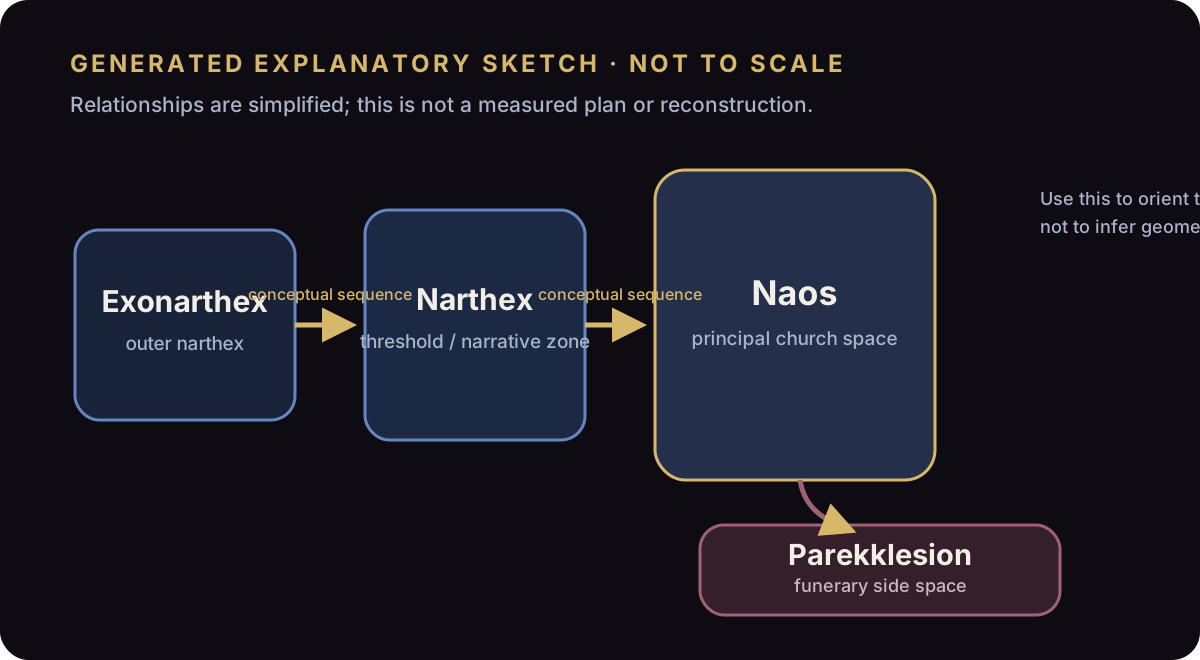
Follow explicit spatial connections.
Figures + iconography
4 directDecoder + visual grammar
0 directNo direct edge in this part of the current graph.
Materials + making
2 directHistory + chronology
1 directPlaces + monuments
1 directZones + spatial models
6 directKeep intermediate evidence visible.
- Figures + iconographyTwo-step navigation path, not a new placement or causal claim.
- Figures + iconographyTwo-step navigation path, not a new placement or causal claim.
- Decoder + visual grammarTwo-step navigation path, not a new placement or causal claim.
- Decoder + visual grammarTwo-step navigation path, not a new placement or causal claim.
- Materials + makingTwo-step navigation path, not a new placement or causal claim.
- Materials + makingTwo-step navigation path, not a new placement or causal claim.
- History + chronologyChora Church / MonasteryTwo-step navigation path, not a new placement or causal claim.
← represented-atAnastasis / Harrowing of Hellgrows-in-prominence-afterRestoration of Images, 843 - History + chronologyChora Church / MonasteryTwo-step navigation path, not a new placement or causal claim.
← represented-atAnastasis / Harrowing of Hell← increases-prominence-ofPost-Iconoclast Church-Decoration Programs - Places + monumentsTwo-step navigation path, not a new placement or causal claim.
- Places + monumentsTwo-step navigation path, not a new placement or causal claim.
- Zones + spatial modelsTwo-step navigation path, not a new placement or causal claim.
- Zones + spatial modelsTwo-step navigation path, not a new placement or causal claim.
Sources supporting this profile.
Picturing salvation — Chora’s brilliant Byzantine mosaics and frescoes
Open source ↗
Byzantine architecture and monumental art after iconoclasm
Open source ↗
Constantinople & Marmara
4th–15th c. Byzantine core; records vary · 1 registered source
Imperial-capital and Marmara/Nicaean context.
Production evidence is strongest when museum records explicitly say Constantinople or probably Constantinople; monument profiles describe use in situ.
Movement is not inferred from capital association alone.
Imperial, patriarchal, conciliar and court contexts are kept separate from workshop attribution.
Capital prestige and comparison can be discussed without assigning every related work to a Constantinopolitan workshop.
Later reception is connected only through explicit legacy/network records.
Map position, proximity or visual similarity never creates a transmission edge. Follow the named source and explicit relationship records.
Follow explicit geographic and transmission connections.
Places + regional groupings
2 directVerified objects
0 directNo direct edge in this part of the current graph.
Icon types + scenes
4 directMaterials + making
2 directHistory + actors
1 directSacred-space evidence
5 directConcepts + transmission methods
1 directKeep the intermediate evidence visible.
Sources supporting this profile.
Picturing salvation — Chora’s brilliant Byzantine mosaics and frescoes
Open source ↗
Where can this record lead?
14 bounded direct results · 12 bounded two-step paths · 2 navigation themes
Keep the intermediate record in view.
- Two explicit edges; intermediate record remains visible.
- Two explicit edges; intermediate record remains visible.
- Two explicit edges; intermediate record remains visible.
Reason across history, geography, and evidence
BIU navigation synthesis maps Place / places-networks records to this preserved learning path; this is a learning suggestion, not historical importance.
Open learning step →Connected record
Source trail
Picturing salvation — Chora’s brilliant Byzantine mosaics and frescoes
Open source ↗
ICU / CONNECTED DISCOVERY
Continue through related ideas.
These are bounded editorial connections; paid placement does not influence them.
Loading public connections…