
 Diagram
Atmospheric layering
Layering is useful for explaining relative height and structure, but a schematic cannot substitute for a measured sounding.
Representation Gallery
A photograph, long exposure, satellite composite, scientific diagram and painting can all be truthful in different ways — but they are not interchangeable evidence.
DiagramLayering is useful for explaining relative height and structure, but a schematic cannot substitute for a measured sounding.
 Perceptual diagram
Loss of contrast with distance communicates fog better than a uniform gray overlay. This is a perception cue, not a quantitative visibility estimate.
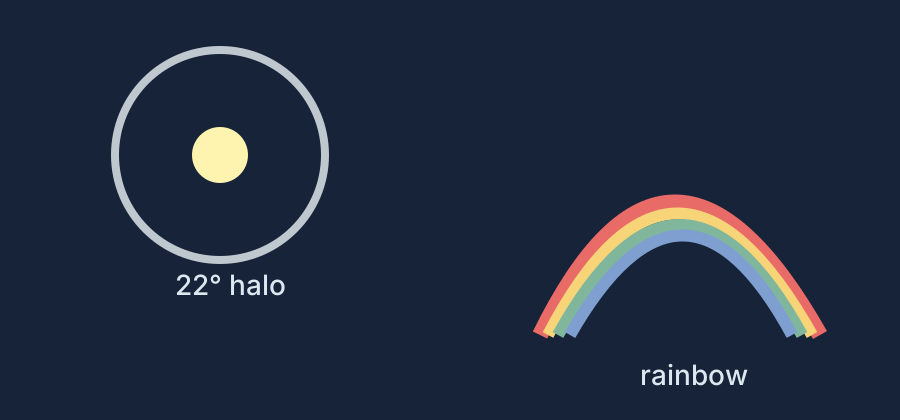 Geometry sketch
A halo centers on the light source; a rainbow is observer-dependent and appears opposite the Sun. Explanatory geometry should not be mistaken for a photograph.
 Concept sketch
Charge regions and lightning are simplified so the relationship is legible. Real storm electrification is more complex and variable.
 Stylized icon
Six-fold symmetry is physically grounded, but this drawing is not a micrograph or a claim that every snow crystal has this exact branching pattern.
History of representation
Luke Howard’s early nineteenth-century cloud nomenclature helped establish the Latin-based naming lineage that underlies modern cloud classification. Institutional histories also document how this framework influenced artists including J. M. W. Turner and John Constable. This universe treats that history as a bridge between scientific description and visual culture, not as proof that an artwork is meteorological data.